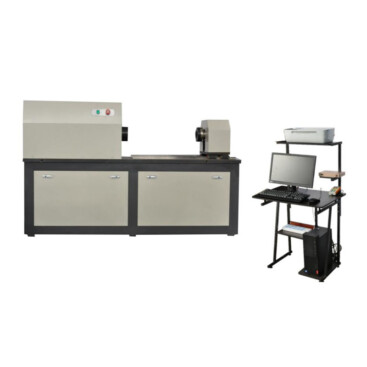
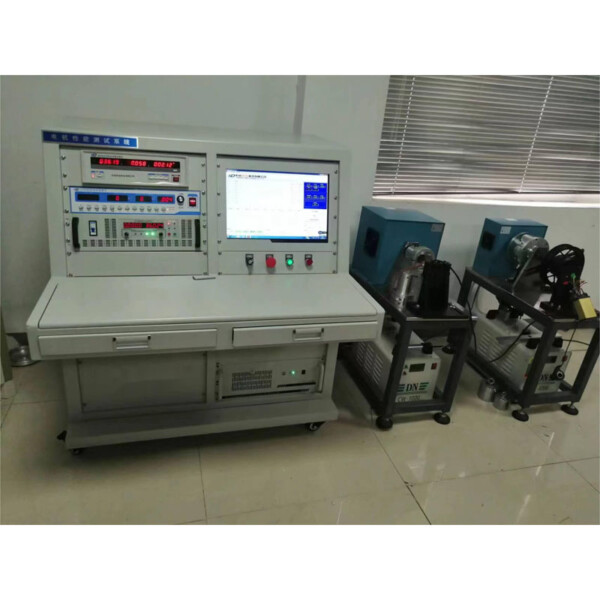
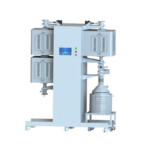
Motor Online and Aging Test System Torque-speed Analyzer Motor Performance and Temperature Rise Tester
- คำอธิบาย
- สอบถามรายละเอียดเพิ่มเติม
คำอธิบาย
ภาพรวมของระบบ
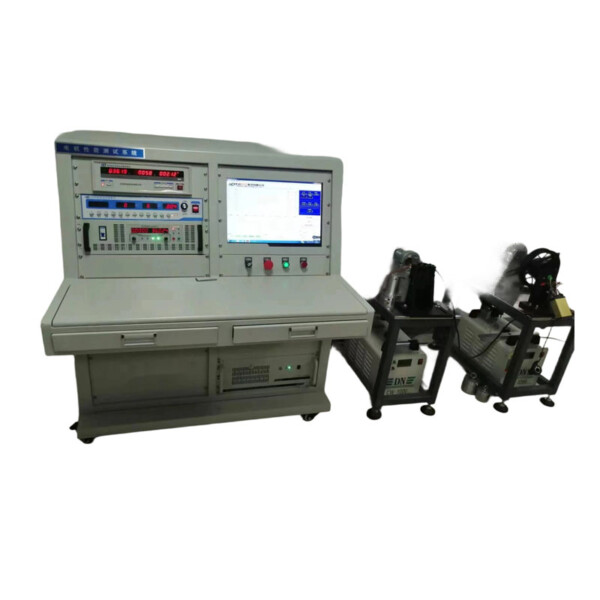
This test system is a dedicated testing equipment for motor performance and temperature rise.
ส่วนใหญ่จะประกอบด้วย:
- No-load performance test
- Load performance test
- Fixed-point test
- Locked-rotor test
- Online test
- Aging test
The system adopts high-precision power analyzers and torque-speed measuring instruments, which can accurately measure the voltage, ปัจจุบัน, กำลังไฟฟ้าเข้า, ความเร็ว, แรงบิด, กำลังขับ, and efficiency of various types and grades of motors.
This system is a dedicated testing equipment for motor performance. It features high testing accuracy, การทำซ้ำที่ดี, เสถียรภาพการดำเนินงานที่แข็งแกร่ง, ประสิทธิภาพแบบขนานสูง, อายุการใช้งานยาวนาน, และใช้งานง่าย. It has both manual and automatic control modes. The manual control mode operates independently of the computer system, while the automatic control mode is controlled by the computer. The automatic test system provides full Chinese software, ซึ่งสามารถแสดงและพิมพ์เส้นโค้งและข้อมูลลักษณะเอาต์พุตได้:
น = ฉ(ยู, ฉัน, ป1, COSφ, ม, ป2, ที่)
ม = ฉ(ยู, ฉัน, ป1, n, COSφ, ป2, ที่)
สามารถทดสอบและแสดงข้อมูลต่อไปนี้ได้: แรงดันไฟฟ้าอินพุต, ปัจจุบัน, กำลังไฟฟ้าเข้า, แรงบิด, ความเร็ว, กำลังขับ, และประสิทธิภาพของมอเตอร์ที่ทดสอบ. สามารถแสดงและพิมพ์ข้อมูลการทดสอบและโหลดเส้นโค้งลักษณะเฉพาะได้, มีรูปแบบเอาต์พุตหลายรูปแบบ.
รายการทดสอบ
2.1 แรงดันไฟฟ้าขาเข้าของมอเตอร์, ปัจจุบัน, และพลัง
2.2 แรงบิดเอาท์พุตของมอเตอร์, ความเร็ว, และกำลังไฟฟ้าขาออก
2.3 Overall efficiency
Measuring Instruments
4.1. Motor Performance Analyzer (Speed and Torque Measurement Instrument)
1) Measurement Range and Accuracy:
2) สภาพแวดล้อมการทำงาน:
อุณหภูมิ: (0~40)℃;
ความชื้น: (20%~75%) RH;
Atmospheric Pressure: (86~106) ปาสคาล;
Instrument Power Supply: AC220V±22V, 50Hz±1Hz;
3) Comparison
The torque and speed analyzer provides a variety of test modes, including three basic modes (excitation current, ความเร็วคงที่, and constant torque) and three special modes (automatic slope, endurance test, and stall point test). The three basic modes can be quickly switched using the “PID Mode” button on the instrument’s front panel. Special modes require a PC or standalone device to complete the testing functions, breaking away from traditional measurement methods.
4) PID Calculation Method
The controller uses a PID (proportional, integral, and derivative) control law. When the controller and the controlled object form a closed-loop control circuit, to ensure that the system operates with optimal dynamic and static performance, the proportional coefficient and integral and derivative time constants of the control loop need to be tuned according to the specific conditions of the controlled object. The system’s dynamic performance is mainly determined by the proportional coefficient. The purpose of tuning the proportional coefficient is to ensure stable operation while achieving the fastest response speed and the smallest steady-state error (the difference between the set value and the actual output value). The integral term eliminates the system’s steady-state error. If the integral action is too strong, it will cause oscillations in the system; if the integral action is too weak, it will take too long to eliminate the steady-state error. Tuning the integral time constant aims to ensure that the control loop eliminates the steady-state error as quickly as possible while maintaining stable operation. The derivative term suppresses oscillations and reduces hysteresis. If the derivative action is too weak, the effect is not obvious; if the derivative action is too strong, it will amplify system noise, making the system operation erratic.
The dynamometer controller divides the PID coefficients (representing the strength of proportional, integral, and derivative actions) into 0-99 levels according to their strength. These codes (0-99) are called PID parameters. Each different control mode requires its own independent set of PID parameters. The tuning of the P parameter involves finding the P value close to the critical oscillation point to minimize the steady-state error and achieve the fastest response. When tuning PID parameters, the order should be P, ฉัน, และ D. อันดับแรก, tune the proportional parameter. When searching for the optimal proportional parameter, the effects of integral and derivative actions should be minimized to avoid their influence. If the approximate range of the proportional parameter is unknown beforehand, it is easy to adjust the proportional parameter from small to large. For each value tested, the setpoint of the controlled variable should be changed significantly. If no oscillation occurs, the value can be increased further until the point where oscillation begins is found. แล้ว, decrease the proportional parameter by one step to obtain the optimal proportional parameter.
The tuning of the I parameter involves finding the I value close to the critical oscillation point to minimize the time to reach the setpoint.
After tuning the P parameter, tune the I parameter under the optimal P parameter. ในทำนองเดียวกัน, the integral parameter should be adjusted from small to large. For each value tested, the setpoint of the controlled variable should be changed significantly. If no oscillation occurs, the value can be increased further until the point where oscillation begins is found. แล้ว, decrease the integral parameter by one step to obtain the optimal integral parameter.
The tuning of the D parameter involves finding a suitable D value that can significantly suppress overshoot without causing significant noise. ในที่สุด, tune the D parameter. Under the optimal P and I parameters, adjust the derivative parameter from small to large. อย่างไรก็ตาม, the D parameter does not have a clear oscillation boundary like the P and I parameters. As the D value increases, periodic oscillation will not occur, but rather increasingly noticeable random noise. ดังนั้น, when adjusting the D parameter, it is not necessary to seek the optimal critical value as with the P and I parameters; simply find a value that significantly suppresses overshoot without causing significant noise.
4.2 Electrical Parameter Tester
Main performance and technical specifications:
| พารามิเตอร์ | ช่วงการวัด: | Working error: | ปณิธาน: | หมายเหตุ: |
| แรงดันไฟฟ้า | (1–300) วี | ± (0.4% ของการอ่าน + 0.1% เต็มรูปแบบ)
Working error: |
<100 วี: 0.01 วี
≥100 V: 0.1 วี |
Overload up to 1.2 times the range is permitted. |
| ปัจจุบัน | (0.005–20) ก | 0.001 ก | Overload up to 1.2 times the range is permitted. |
Input method: Both voltage and current are floating inputs;
Maximum peak value of measurement signal: Both voltage and current are 1.6 times the maximum range;
Conversion rate: ประมาณ 4000 times/second;
Display update: ประมาณ 5 times/second;
Overall power consumption: < 5ว;
น้ำหนักเครื่องมือ: ประมาณ 3 กิโลกรัม;
ขนาดเครื่องมือ: Width x Height x Depth: (310 x 121 x 328) มม. Opening dimensions: Width x Height (307 x 102) มม
สภาพแวดล้อมการทำงาน:
ความกดอากาศ: (86–106) ปาสคาล;
อุณหภูมิ: (0–40) ℃;
ความชื้นสัมพัทธ์: ≤85% ความชื้น
Instrument power supply: AC 220V±15% 50/60Hz
ข้อกำหนดทั่วไป:
ความต้านทานของฉนวน: The insulation resistance between the following terminals shall be no less than 2MΩ;
Withstand voltage: The following terminals shall withstand a 2000V 50Hz sine wave voltage;
Between the measuring terminals and the casing; between the power cord and the casing; between the measuring terminals and the power cord.
บันทึก: For definitions of the terms used in the above technical parameter descriptions, please refer to GB/T 13978-1992 “General Technical Specifications for Digital Multimeters”.
Software Function Introduction
- รายการทดสอบ:
(1) During no-load, โหลด, and locked-rotor tests, safety values for current, แรงบิด, ความเร็ว, and output power can be set, enabling automatic limit triggering.
(2) Automatic and Manual Load Testing:
Load test loading speed is adjustable: adjustable according to actual needs.
Test load increment is adjustable: the initial load and increment can be set.
(3) Fixed-Point Testing: ปัจจุบัน, แรงบิด, ความเร็ว, and power can be tested. Testing can be performed at a single point without unloading; or at multiple points with unloading.
(4) Endurance Testing: Operating modes: no-load, แรงบิด, กำลังไฟฟ้าเข้า, กำลังขับ, and other parameters can be freely set; the endurance value and error value under each item can be freely set; the test time can also be freely set.
- Nameplate Parameters:
Motor model, กำลังไฟพิกัด, rated voltage, ความเร็วสูงสุด, customer name, customer file, test personnel, วันที่ทดสอบ.
- Curve Coordinates:
(1) Two modes, seven coordinate curves.
(2) Two modes: speed mode and torque mode. These two modes only represent different ways of analyzing the data.
(3) Seven curves: แรงดันไฟฟ้า, ปัจจุบัน, ความเร็ว, แรงบิด, กำลังไฟฟ้าเข้า, กำลังขับ, และประสิทธิภาพ. The maximum value and color of each curve can be freely set for convenient data analysis.
- Storage and Retrieval of Motor Parameters:
After setting the parameters for each motor, they can be stored for future use and retrieval without needing to reset them.
- Motor Performance Test Interface:
The testing interface can display real-time test data (แรงดันไฟฟ้า, ปัจจุบัน, ความเร็ว, แรงบิด, กำลังไฟฟ้าเข้า, กำลังขับ, และประสิทธิภาพ) and collect data at set intervals (which can be freely configured). Curves are automatically plotted during the testing process, allowing for better monitoring of the test.
- Report Analysis:
(1) Curve graphs of the entire testing process (แรงดันไฟฟ้า, ปัจจุบัน, ความเร็ว, แรงบิด, กำลังไฟฟ้าเข้า, กำลังขับ, และประสิทธิภาพ)
(2) Nameplate parameter values
(3) Key motor performance analysis points:
No-load point: Current value and speed value
Maximum torque point: Torque value, speed value, ค่าปัจจุบัน, output power value, and efficiency value
Maximum output power point: Torque value, speed value, ค่าปัจจุบัน, output power value, and efficiency value
Highest efficiency point: Torque value, speed value, ค่าปัจจุบัน, output power value, and efficiency value
Main Configuration List
| General term | ชื่อ | หน่วย | ปริมาณ | ข้อสังเกต |
| Dynamometer loading system | High-precision magnetic powder dynamometer | ชุด | 2 | ความเร็วในการหมุน: 3000 รอบต่อนาที
Rated torque: 10 น.ม Built-in torque and speed sensor วิธีการทำความเย็น: ระบายความร้อนด้วยน้ำ |
| Dynamometer test bench | ชุด | 2 | การกำหนดค่ามาตรฐาน | |
| Chiller | ชุด | 2 | การกำหนดค่ามาตรฐาน | |
| Motor-specific mounting fixture | ชุด | 2 | Customized according to customer product specifications, including coupling | |
| Calibration tooling | ชุด | 1 | Free gift | |
| Measurement and control section | Torque and speed measurement and control instrument | หน่วย | 2 | การควบคุม PID, communication method, remote/local selectable, disturbance-free switching of control modes, includes torque signal acquisition module. Can automatically load, maintain constant speed, and maintain constant torque. Includes excitation loading. |
| Electrical parameter tester | หน่วย | 2 | แรงดันไฟฟ้า: 300V Current: 20ก | |
| Operator console | ชุด | 1 | Vertical control panel including key switch, emergency stop button, start/stop buttons, ฟิวส์, contactor, ฯลฯ. | |
| คอมพิวเตอร์อุตสาหกรรม | ชุด | 1 | Yanxiang IPC310, 17-inch Lenovo monitor, 6 serial ports, พอร์ตเครือข่าย, อินเตอร์เฟซ USB | |
| บมจ | ชุด | 1 | Mitsubishi | |
| Testing software | ชุด | 1 | Motor testing dedicated software |